Welding Thickness Calculator
Last updated: October 6, 2026
Free settings card — print it, 10 minutes.
Welder settings calculator for hobbyists running MIG/TIG/stick.
Enter the metal thickness. Get the TIG amps, the MIG wire and settings, or the stick rod and amperage range — the published rules of thumb, computed. Plus duty-cycle runtime math.
1/16" = 62 · 1/8" = 125 · 3/16" = 188 · 1/4" = 250
As an Amazon Associate I earn from qualifying purchases. The Amazon links below are affiliate links; they don't change the math.
Sheet 16 ga ≈ 62 · 1/8" = 125 · 3/16" = 188
How long can you actually weld before the machine cuts out? Duty cycle is thermal — it scales with the square of the amperage ratio.
How does this welding calculator work?
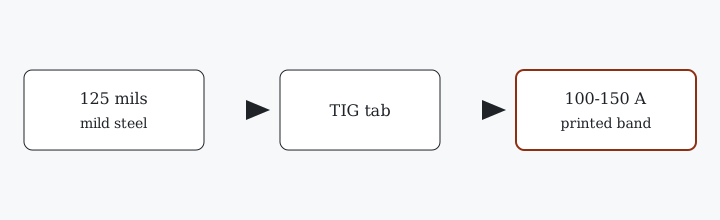
Welding sizing is built on three published approximations that machine makers have taught for decades. TIG: about 1 amp per 0.001 inch of mild steel — 1/8" steel starts near 125 A. For 1/8" aluminum the TIG tab uses Miller’s GTAW section 8-3 butt start, 90–120 A, instead of multiplying the steel rule by 1.5. Other aluminum thicknesses use a published Lincoln row, or the nearest published row, with no interpolated amps. Stick: rod diameter ≈ half the base-metal thickness, then look up the amperage window for that rod size and type. MIG: wire size follows thickness (0.023" under 3/32", 0.030" through 3/16", 0.035" above), and wire speed scales with amps. None of these replace a test bead — every real shop tunes on scrap first.
Methodology & disclosure: the calculator applies the published rules of thumb on this page in your browser. It is a planning estimate, not a measured result — confirm every setting on scrap first. Amazon links on this site are affiliate links; they do not change the math.
What amps and machine class does each steel thickness need?
| Steel thickness | TIG amps | Stick rod | Machine class |
|---|---|---|---|
| 1/16" (62 mils) | 50–75 | 1/16" E6011 @ 35–60 | 120 V hobby |
| 1/8" (125 mils) | 100–150 | 1/8" E6011 @ 75–125 | 120 V ok, 240 V comfortable |
| 3/16" (188 mils) | 150–225 | 5/32" E6011 @ 110–165 | 240 V |
| 1/4" (250 mils) | 200–300 | 1/8" @ 90–140, multi-pass | 240 V, 180–220 A |
| 3/8"+ (375+) | 300+ | Multi-pass, preheat | Shop machine |
Amp windows from published electrode and machine-manufacturer charts (Lincoln, Miller, ESAB). Rod-diameter rule: electrode diameter ≈ half the base-metal thickness, never smaller than 1/16".
Sourced data table + CSV: stick electrode amperage by rod and diameter
Common questions, answered
How many amps do I need to weld 1/8 inch steel?
Roughly 100–125 amps. The published rule of thumb for mild steel TIG is about 1 amp per 0.001 inch of thickness, so 1/8 inch (125 mils) starts near 125 A. For stick, a 1/8" E6011 runs about 75–125 A (see the quick-reference table). Always confirm the exact setting on scrap first.
What size stick rod for 1/4 inch steel?
The rule is a rod diameter about half the base-metal thickness: 1/4 inch (0.250") takes a 1/8" rod. Run E6011 at 75–125 A if the metal is rusty or painted; run E7018 at 90–140 A on clean steel for a stronger, cleaner deposit. A 120 V 140 A machine can burn 1/8" rod, but a 240 V machine makes 1/4 inch comfortable.
What does duty cycle actually mean on a welder?
Duty cycle is rated over a 10-minute window: a 140 A machine at 30% duty can weld 3 minutes per 10 at full output, then must cool. Duty cycle scales with the square of the amperage ratio — welding at half the rated amps roughly quadruples the effective duty cycle; welding above rated output collapses it quickly.
Can a 140 amp welder weld 1/4 inch steel?
Yes, single-pass with stick or flux-core if you bevel the joint and don't rush. Full-strength multi-pass welds on 1/4 inch want 180–220 A. For structural work on 1/4 inch and up, a 200 A-class machine is the honest answer; a 140 A machine is a maintenance-class tool.
Common questions
Each question below is a full page, with the published figure and the source it comes from.
By thickness
- What size welder do I need for 18 gauge sheet metal?
- What size welder do I need for 16 gauge steel?
- What size welder do I need for 10 gauge steel?
- What size welder do I need for 1/8 inch steel?
- What size welder do I need for 3/16 inch steel?
- What size welder do I need for 3/8 inch steel?
- What size welder do I need for 1/2 inch steel?
By job
Guides
What size welder for 1/4 inch steel?
The most-searched buyer question, answered honestly: what 140 A machines can and can't do, and why 1/4" is the line between hobby and shop machines.
MIG or TIG for 16–20 ga sheet metal?
Why thin metal warps, which process controls it, and the settings that keep auto-body and ductwork panels flat.
Best beginner welder by the thickness you'll actually weld
Flip the usual advice: pick the metal first, then the machine. 120 V flux-core vs a 140 A MIG vs a 200 A TIG — where each one earns its money.
Running a welder off a generator? ↗
A 200 A stick welder draws real surge power — GeneratorSizer does the generator-side math.
TIG amps by material thickness — the 1-amp-per-mil rule, tuned
Where the classic rule breaks: aluminum conductivity, stainless, thick plate, and the tungsten and filler to pair with each range.
MIG wire speed chart — ipm settings by thickness and amperage
Stop guessing the dial: ipm windows for 0.023–0.045 wire paired with voltage, by material thickness.
Process, cleaning, and safety
- How to weld aluminum — 1/8 inch stays Miller’s 90–120 A butt start; other thicknesses use a published Lincoln row or the nearest one.
- What is arc welding? — OSHA’s fusion types, then one thickness in three processes.
- How to weld — Measure, pick the rod, then read duty cycle.
- How to get into welding — BLS education, pay, and outlook only.
- How to clean metal before welding — Coatings off, then the clean-versus-rusty rod.
- How to weld carbon steel — Miller’s 125 A example beside this MIG tab.
- How to choose a stick welder — 90–140 A is not the 175–250 A class.
- How to weld galvanized steel safely — Zinc fume controls before any amp.
- How to TIG weld stainless steel — The 0.9 factor beside Lincoln’s stainless column.
- Stick welding amperage chart — The windows the stick tab prints.
- What to wear when welding — OSHA’s shade table by electrode size.
- Welder duty cycle and amperage chart — nameplate process, voltage, amp range, and rated duty cycle.
- Embed this calculator — the same four tabs in an iframe.
Sources & Standards
Solid-wire MIG starting points on this site follow the Miller page below: 1 amp per .001 inch of steel, and the wire-speed multipliers.